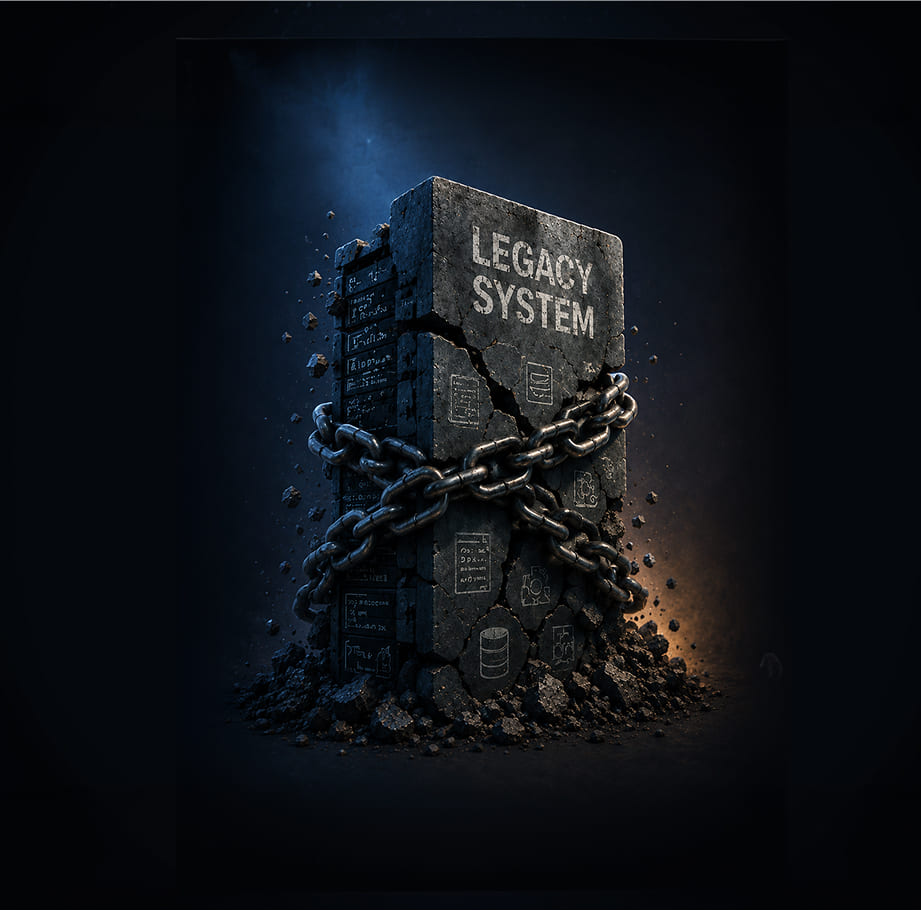
What Is Legacy Modernization?

As a legacy modernization company, GP Solutions uses a range of strategies to rejuvenate your tech stack, depending on your specific needs:
- Rehost & Replatform: Move to modern environments without disruption.
- Refactor & Rearchitect: Optimize your code and structure to enhance efficiency and cloud-native performance.
- Rebuild & Replace: Clean-slate development, when your business requires a complete digital transformation.
The aim is clear: our experts will help you untangle technical debt and retain the business value you’ve been accumulating all these years. We do not “just fix the old”. Our legacy system modernization services are about investing in a future that unlocks cloud adoption, drives ongoing innovations, and maintains your long-term competitiveness in a digital-first world.
Challenges You Can Address with Our Legacy Modernization Services
- Rising maintenance costs
- Outdated infrastructure
- Security risks
- Unsupported and/or outdated technologies
- Limited scalability
- Slow delivery cycles
- Undocumented systems and codebases
- Dependency on retiring experts
- Poor user experience
- Fragile integrations
- High technical debt
- Complex data migration
- Business continuity risks
- Compliance gaps
- Danger of delayed modernization
Teams that approach our legacy system modernization company already know something is wrong.
They just don’t know how wrong or where to start.
Our Legacy System Modernization Services
GP Solutions provides full-cycle legacy modernization services — from initial architecture assessment all the way to post-deployment support. The scope will be determined solely by the need of your system.
Assessment and Strategy
- Legacy system audit
- Review of architecture and code
- Dependency mapping
- Risk identification
- Modernization roadmap
Transformation and Engineering
- Refactoring and modularization
- Replatforming, rearchitecting, and rehosting
- Rebuild and replacement of the system
- Service extraction
- DevOps modernization
Cloud and Infrastructure
- Cloud migration
- Infrastructure modernization
- Containerization
- Network transformation
- CI/CD pipeline implementation
Interface and Data
- UI/UX modernization
- Database modernization
- Data platform redesign
- API enablement and integration
- Performance optimization
Security and Compliance
- Security architecture upgrades
- Compliance gap remediation
- Vulnerability assessment
- Documentation recovery
- Ongoing engineering support
Legacy System Modernization Consulting

Our consulting services include:
- System audit
- Architecture assessment
- Code review
- Dependency mapping
- Technology inventory
- Risk analysis
From those findings, we proceed to devising your modernization plan: phased, sequenced, costed, and focused on business continuity. It normally covers:
- Technology recommendations
- Risk-adjusted sequencing
- Cost estimates
- Clear justifications for any significant decision
The strategy belongs to you. If you choose us as your legacy modernization partner, we follow it. Otherwise, you’re still left with something that’s worth having.
Industries We Serve
Brands That Trust Us
Benefits of Legacy Modernization

- Cut down operational costs
- Enhance overall performance
- Strengthen your system against security vulnerabilities
- Prepare your business for compliance checkups
- Scale with cloud-native technology
- Improve user experience
- Speed up delivery cycles
- Launch innovations company-wide
- Make your architecture future-proof
- Optimize infrastructure spending
- Unlock integrations hindered by your tech
- Extract value from legacy tech
Types of Legacy Systems We Modernize
With deep technical heritage and cutting-edge capabilities, GP Solutions can modernize systems from any era. From legacy infrastructure with decades of logic to an early-generation cloud deployment, we transform:
Mainframe and Core Infrastructure:
COBOL systems, in particular mainframes, Natural, Adabas, JCL, CICS, and DB2.
Languages and Middleware:
Complex Architectures:
Monolithic applications, control card-based systems, and cloud-based legacy applications.
Enterprise Platforms:
Legacy ERP systems, CMS platforms, and highly regulated systems.
End-User Applications:
Legacy desktop applications, web applications, and mobile applications.
Our Modernization Process
You can witness a visible result of each phase of our legacy system modernization services prior to the start of the next phase.

Legacy System Assessment
We determine what there is before offering suggestions as to what to do with it.
- Architecture analysis
- Code review
- Dependency audit
- Issue identification
- Technology inventory
Strategy and Roadmap
All decisions (sequencing, technology, cost, risk) are taken prior to execution.
- Modernization model selection
- Technology decisions
- Phased sequencing
- Cost estimation
- Business continuity mapping
Execution
Structured delivery phases. Nothing moves forward without validation.
- Engineering delivery
- Continuous testing
- Documentation
- UAT feedback loops
Deployment and Stabilization
System activation. The team is ready. Monitoring is in progress.
- Production deployment
- Team training
- Performance validation
- Issue resolution
Ongoing Support
Changes are not over after launch. Our involvement is not either.
- Continuous updates
- Performance optimization
- Post-launch engineering partnership
How We Ensure High‑Quality Legacy Modernization Services

As an experienced legacy system modernization company, GP Solutions applies the best practices for quality assurance throughout the project lifecycle:
- Architecture best practices
- Clean code standards
- Comprehensive testing techniques (automated, manual, performance, security)
- CI and CD pipelines
- Compliance checks
- Clear documentation
- Continuous optimization
- Stable deployment practices
Case Studies

Dedicated IT Services for a Flagship Automotive Company
Though having an established team of their own, the client looked for improvements in architecture design, development process coordination, and the roll-out process for new modules and updates. Check how we positively impacted the release of market versions of the client’s e-commerce platform.

Enhancing E-commerce Apps for a Leading German Retail Chain
Learn what we did for our German client to redesign Android and iOS mobile apps and improve user experience. In the end, app users got a better search functionality, were able to use apps on more external devices, and enjoyed the overall smooth experience when using the client’s apps.

Next-Gen Back Office & CRM for a Leading Visa & MasterCard Provider
Learn how the GP team improved the older version of the client’s system and developed a new CRM solution extended with e-commerce and customer loyalty functionality. The back office we upgraded now operates to distribute and service Visa and MasterCard offers.
Working with an undocumented or high-risk legacy system?
Documentation recovery and risk mapping are built into our process. Tell us what you’re dealing with.
Technologies and Innovative Capabilities
When we choose technology for your project, we follow architecture requirements and business goals. The stack serves the system. Not the other way around.
Cloud & DevOps
- AWS
- Azure
- Google Cloud
- Docker
- Jenkins
- CI/CD Pipelines
Frontend
- React
- Angular
- Vue.js
- JavaScript
Data and Databases
- PostgreSQL
- MySQL
- Microsoft SQL Server
- MongoDB
- Apache Druid
AI and Emerging Tech
- AI and ML integration
- Computer vision
- Python ML libraries
- OpenAI API
- Custom model integration
AI-Driven Modernization

At our legacy modernization company, engineers are always open to new opportunities that can make our job better and faster. Our team will be happy to extend our services with AI development and integration capabilities.
GP Solutions integrates AI-powered tooling into its modernization workflows:
Automated code analysis’
- Dependency mapping
- Refactoring recommendations
- Test case generation
- Documentation reconstruction
- Predictive risk analysis
- Agentic AI automation
Let Our Clients Do the Talking
Why They Choose Our Legacy Modernization Services
Cross-Functional Teams
With GP Solutions, you get engineering, product, and UX design services from the same roadmap. From the outset the people making architecture decisions and the people designing the experience your business will operate in are in the same conversation.
Reuse-First Approach
We maintain your existing functional business logic. For systems that have been in existence for many decades, that logic is the most important part of the codebase, even if the rest of the code is not.
Architecture Based on Business Goals
Not technology preference. Not vendor relationships. But what the system should be doing in three years. This distinction matters most where a technically elegant solution and a business-appropriate solution diverge.
Modernization without Organizational Disruption
Many legacy modernization efforts fail, and not just because of technical issues. GP Solutions fits into your existing structure, aligning with teams, speaking in your language, and working around your schedule.
Incremental Delivery by Design
Phased application modernization minimizes risk in each phase. The business continues to operate as the system develops. We clearly define, check, and approve each phase prior to the start of the next one. We never take a leap for a direction that we haven’t previously substantiated with evidence.
Over 20 Years in Regulated and Complex Environments
GP Solutions has seen firsthand how a modernization failure can be a regulatory disaster or a seven-figure outage in banking systems, insurance infrastructure, and healthcare systems.
How We Approach a Modernization Project

Our Legacy Modernization Flow
- Requirements discussion
- Legacy system audit
- Modernization roadmap creation
- Proposal and agreement
- Team selection
- Onboarding
- Project kickoff
Most teams already have a shortlist of systems they’re worried about. We start there.
Looking for Another Tech?
Frequently Asked Questions
What is legacy modernization?
Legacy modernization is a decision-making process as much as an engineering one. Most organizations know their legacy system is slowing them down. They don’t know which parts are worth saving and which are costing more than they’re worth. Modernization answers that question with evidence, then acts on it. The outcome is a system that fits how the business operates today, built on what was already working underneath.
How do you handle systems with no documentation?
We treat it as a starting condition. It is not a blocker for our team. The first thing we do is the reconstruction of what’s there: through code analysis, dependency tracing, and conversations with the people who’ve been keeping the system alive. By the time modernization work begins, the system is understood. Often better than it was before we arrived.
Can modernization happen without full replacement?
Full replacement is the last option we reach for, not the first. Most systems contain years of accumulated business logic that a rewrite would have to rediscover from scratch and at significant cost and risk. The question is always whether transformation or targeted rebuilding can achieve the same result with less disruption. Usually it can.
How do you ensure business continuity during modernization?
Every roadmap includes a business continuity plan. Work is sequenced to minimize operational exposure. Parallel systems are maintained where risk requires it. We validate each phase before the next begins. The business doesn’t pause for modernization — the modernization is designed around the business.
How much does modernization cost?
Scope, complexity, and approach determine cost. This is why we don’t provide estimates before the audit. A number built on assumptions about what legacy systems typically look like isn’t an estimate. It’s a guess with a decimal point. Detailed, defensible cost figures come after we’ve seen what we’re dealing with in practice.
Why do modernization projects fail?
Rarely for technical reasons. The most common causes are organizational: poor planning, underestimated system complexity, insufficient risk mapping, and teams without direct experience in legacy environments. The audit addresses the first three. The fourth is where GP Solutions’ 20 years of working inside complex, underdocumented, business-critical systems are the deciding factor.
How long does a modernization project take?
It depends on system complexity, the approach selected, and how much change the organization can absorb at each phase. Rehosting can be completed in weeks. Full rearchitecting or rebuilding engagements for complex enterprise systems span months. We deliver them in defined phases, each producing a validated output before the next begins. Timeline estimates are part of the roadmap developed after the initial audit.