MVP Development Services

Building too much, too early is how good ideas become expensive lessons. GP Solutions scopes, builds, and launches MVPs that generate actual market signals and help you act on early user feedback. Our MVP implementation services support startups, SMBs, and enterprise clients along the entire product journey — from early concept through launch.
DISCUSS YOUR MVP IDEA
keyboard below a blue glowing holographic display featuring an MVP gear and business icons

What Exactly Is MVP Development

A minimum viable product is the earliest functional version of your product that real users can interact with — not a demo, not a prototype, not a Figma file. It runs. People use it; hence, it generates behavior-based feedback that determines the next development phase.

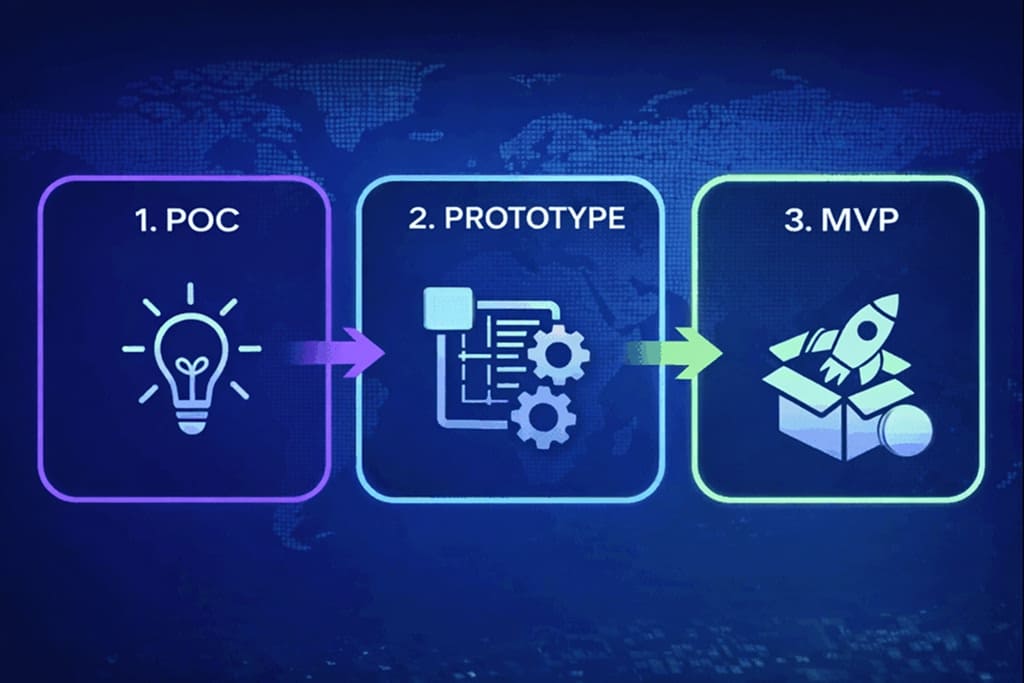
A diagram showing three stages: POC with a lightbulb, Prototype with gears, and MVP with a rocket in a box.

This puts MVPs in a different category from two notions they’re often confused with:

  • A proof of concept (PoC) tests whether something is technically possible. It addresses an engineering question, usually in isolation from real-world users.

  • A prototype is commonly used to model workflows, screens, or interactions before full development, yet it doesn’t behave like a live product.

PoC → prototype → MVP can form a useful progression when a product needs separate technical, UX, and market validation stages. Each stage eliminates a specific category of risk before you commit to the next level of investment. At our MVP development company, we can run all three and know when each one is the right tool.

Why Businesses Choose to Start with an MVP

Before real users interact with your product, many product decisions remain assumptions rather than validated findings. Some are correct. Some aren’t. MVP development is how you find out which is which before proceeding to broader implementation.

Test Market Demand

Validate whether users want your product before committing to full-scale software development. Observed user behavior beats internal assumptions.

Attract Early Adopters

The users who find you first are worth more than any focus group. An MVP gives them something tangible to interact with and creates a practical source of feedback for future product decisions.

Build Investor-Ready Traction

A live MVP with documented user feedback is a different pitch than a deck with projections. Our MVP app development company helps clients build the kind of evidence that can support investor and stakeholder conversations.

Control Risk and Budget

Launching a full product before validation can increase delivery and market risk. An MVP breaks that into smaller, faster bets, each one informed by the last.

Nico from GP Solutions

Not sure where your idea sits on the PoC–prototype–MVP spectrum? That’s where we start.

Niko
Business Development Expert

Our MVP Development & Implementation Services

Most vendors jump straight to development. We offer full-cycle MVP development services, starting with discovery, and stay with you until you’re ready to scale.

01

Discovery & Business Analysis

Engagements commonly begin with a hard look at your business model to clarify your assumptions, risks, and MVP scope. This is where most MVPs win or lose. Get it wrong, and no amount of good engineering fixes it later.

02

Architecture Design

An MVP is not throw-away code. We build an architecture that strikes the balance between time to market and quality. It will support your first product release perfectly, while you will not need to completely redevelop and rewrite it once you gain traction.

03

UX/UI Design & Prototyping

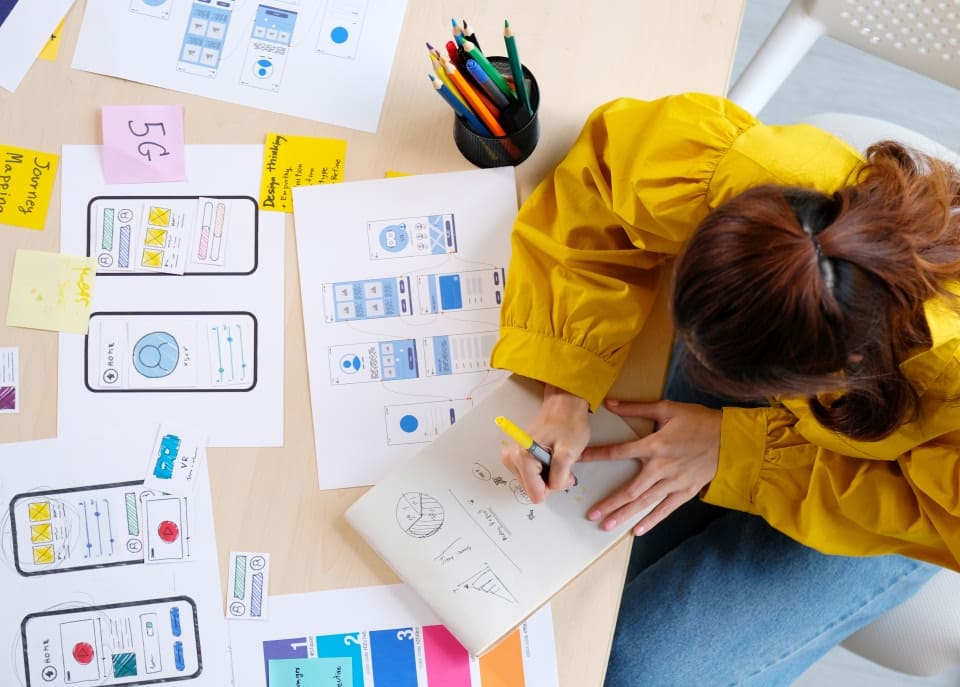
We prototype before we build — always. Interactive mockups get tested against real user flows before the team decides on architecture. Catching design issues in Figma before development is usually faster and less expensive than resolving them later in implementation.

04

Integrations

Software doesn’t exist in isolation. You need payment providers, integration with a CRM system, or other advanced third-party APIs. We make sure your MVP communicates with the broader world so that data can be transmitted securely and efficiently from the beginning.

05

PoC Development

Some technical questions are impossible to answer with confidence until you build something: novel integrations, unconventional data models, or AI components with uncertain performance characteristics. We use targeted proofs of concept to reduce technical uncertainty before full implementation.

06

MVP Software Development

Web, mobile, travel tech, automotive, eCommerce, communication platforms — our 350+ engineers deliver custom MVP app development services across all of these. We prioritize functional requirements around your product’s core goals and validation needs and plan the architecture with both the initial release and future product growth in mind.

07

QA Testing

Beta users have a zero-tolerance policy for bugs. Our quality assurance engineers test in parallel to development, performing intensive manual and automated testing to root out bugs and bottlenecks, ensuring your product is stable and performs optimally.

08

MVP Launch & Iteration

We stay on after launch. Performance monitoring, user feedback analysis, next sprint planning — the work doesn’t stop because the product went live. For most of our clients, launch is where the actual work of improving the product begins.

09

Scaling into a Full Product

An MVP is a starting line, not the destination. After your product’s underlying assumptions are proven to be worth pursuing, we turn our focus to scaling. We add more features, scale your infrastructure to support more users, and evolve your initial product into a fully featured product powered by real-world data.

A man wearing glasses looks at a tablet, surrounded by glowing overlays of a digital brain and data graphs.

MVP Consulting Services

You can’t build a great product without a compelling strategy. With MVP consulting services, our team brings clarity and focus before you start building. We work with you to reduce risk, validate the market, and build only what users want (and nothing else!).

statistics

Market Validation & Analysis

We stress-test your business model, size up the competition, and validate your product idea to ensure there’s a market for your solution before you start building.

gears against screen

Product Vision & Scope

We build a clear vision of your product. Through relentless prioritization, we determine the minimum and maximum scope for your MVP, ensuring quick wins.

Man with a tie

Technology & Risk Management

Our MVP consulting company determines the optimal tech stack to achieve your objectives, preventatively identifying and managing technical and business risks.

Rocket

Roadmapping & Launch Strategy

We give you a practical roadmap and a strategy you need to successfully launch, measure, and plan for the future.

Challenges GP Solutions Solves

A large group of casually dressed people are posing together, all wearing dark shades or sunglasses indoors.

As an experienced MVP development company, we assist our clients in battling the most common challenges they may face during their product implementation:

  • Unclear product vision
  • Lack of technical expertise
  • Uncertain market demand
  • Complex integrations
  • Scalability concerns
  • Need for fast iteration cycles

An MVP tests your business vision before you spend too much money on unnecessary functionality.

Let us show you the way.

What We Build MVPs For

A complex cluster of translucent blue 3D cubes floats against a background of digital code and line graphs.

Our MVP development company extends its services for a large number of MVP solutions:

  • SaaS platforms
  • Web applications
  • Mobile apps
  • eCommerce
  • Fintech products
  • Healthtech solutions
  • AI-enhanced products
  • Chatbots and conversational tools
  • Social platforms
  • Data products

MVP Development Process at GP Solutions

Three glowing metallic gears are interconnected over a blue and purple futuristic digital network background.
01

Discovery & Market Research

We study competitor context, user needs, and the business hypothesis the MVP is meant to test. Everything built after this point traces back to what we learn here.

02

Strategy & Scope Definition

We prioritize features, define boundaries, recommend the right technology stack, and produce a roadmap that separates what gets built now from what gets deferred.

03

Architecture & Tech Stack

We design for the product you’re launching and the one you’re planning to grow into. The codebase is documented, tested, and organized so the next engineer — ours or yours — can pick it up without a forensic exercise.

04

PoC & Prototype

Technical feasibility confirmed. User flows tested. Every question that could derail development gets answered here, not mid-sprint.

05

MVP Development & QA

Your team gets full visibility from kickoff: daily standups, sprint reviews, automated testing pipelines, and open issue tracking throughout every sprint.

06

Launch and Feedback Collection

The product goes live. We track behavior, monitor performance, and turn what users do — not just what they say — into the brief for the next phase.

07

Iteration & Scaling

The same team that scoped and built your MVP helps you evolve it. No re-onboarding, no handoff lag, no explaining the architecture to someone who wasn’t in the room when it was designed.

Mistakes That Kill MVPs and How We Avoid Them

Overbuilding

The instinct to add features “while we’re already building” is one of the most consistent ways MVPs lose their purpose. Scope creep turns a market test into a full product launch with all the risk and none of the validation. We use structured prioritization during planning and delivery to keep the MVP focused on its core objective.

Mistaking Minimum for Low Quality

A product with reliability problems doesn’t generate useful feedback — it generates churn. We maintain full coding standards, CI/CD pipelines, and automated testing on every MVP we deliver. Cutting quality to move faster is a false economy that we don’t offer as an option.

Testing the Wrong Hypothesis

Most MVPs that fail don’t fail because the product was bad. They fail because the question the product was supposed to answer was never clearly defined. Our discovery process exists to frame that question precisely so the MVP generates a signal you can act on.

Building without a Scale Plan

An MVP that succeeds can become a technical liability the moment it grows if the architecture wasn’t designed with that in mind. We think about the next two or three stages of growth before the first sprint begins. Retrofitting architecture into a live product is expensive, disruptive, and entirely avoidable.

450+ projects delivered. 94% of clients stay.

If you’re choosing an MVP development company, that’s the figure we’d ask any vendor to match.

Technologies We Use to Build MVPs

Frontend

Mobile

  • React Native
  • Flutter
  • iOS (Swift)
  • Android (Kotlin)

Databases

  • PostgreSQL
  • MySQL
  • Microsoft SQL Server
  • MongoDB
  • Apache Druid

QA & Testing

  • Automated testing pipelines
  • Selenium
  • Postman
  • Manual QA

Backend

Cloud & DevOps

  • AWS
  • Azure
  • Google Cloud
  • Docker
  • Jenkins
  • CI/CD Pipelines

AI/ML

  • Python ML libraries
  • OpenAI API
  • Custom model integration

Design & Prototyping

  • Figma
  • UX wireframing
  • Interactive prototyping

Why GP Solutions

GP Solutions is a full-cycle MVP software development company that has been building production-grade software since 2002. That’s not a detail we lead with lightly. It means we’ve seen the full lifecycle of product decisions many times over: what works at launch, what breaks under scale, and what kinds of technical debt companies are still paying down five years later.

A collage showing a line of people in profile, a large group posing together, and a woman holding a laptop.
01

Full-Cycle Accountability

Discovery, design, development, QA, and post-launch support live in one team. Nothing gets lost between phases, and there’s no vendor handoff at the moment the project gets complex.

02

Senior-Weighted Teams

Our 350+ professionals include engineers and architects with deep production experience across multiple verticals. The people in your discovery workshop are the people building your product.

03

Business-First Orientation

We’ve spent two decades working with companies across travel, retail, logistics, and car manufacturing. We bring direct domain experience to product decisions, not just technical execution.

04

Architecture That Holds

Every codebase we deliver is documented, tested, and clean enough to hand off — whether the product is growing into a full-scale platform or transitioning to an in-house team.

05

Transparency as Standard

Our MVP implementation services run on full transparency: daily standups, sprint reviews, and open issue tracking throughout. You always know where your product is and why.

Types of Engagement

We believe in flexibility as the key to comfortable collaboration and offer several engagement models to fit any business.

emotional person

Staff Augmentation

Close your skills gaps with our in-house experts.

group of people

Dedicated MVP Development Teams

Opt for a pack of professionals that will be solely responsible for your project.

group of people arranged in trinagle

Full-Cycle MVP Outsourcing

Let us do all the work for you while you are entirely focused on your business development.

Dimitry from GP Solutions

“Tell us what you’re building. We’ll tell you what it takes to build it right.”

Dimitry
Business Development Expert

Trusted by

Education first
StayInTouch
mercedes benz
Air Canada
Parley pro
Galeria Reisen
Versonix
Dohop
Railbookers
xing
Migros
Customers.ai
Bundesministerium für Arbeit und Soziales
westhouse
Tallink

Frequently Asked Questions

How long does an MVP take to build?

Most well-scoped MVPs take between 8 and 20 weeks. The main variable is how much clarity exists going into development. Working with an experienced MVP app development company that brings a defined hypothesis, a prioritized feature set, and completed discovery to the table compresses the timeline significantly.

What’s the difference between a PoC, prototype, and MVP?

A PoC answers a technical question: can this be built? A prototype answers a design question: does this experience make sense to users? An MVP answers a market question: do people want this and will they use it? Each serves a different purpose. They’re not interchangeable, and rushing from PoC to MVP without the prototype phase is one of the more common mistakes in early-stage product development.

Can GP Solutions take over an existing MVP?

Yes. We regularly take over in-progress or stalled projects. We start with a technical audit, assess what’s there, and continue development from a stable foundation.

How do you decide what goes into the MVP and what gets cut?

During discovery, we map every proposed feature against the core hypothesis the MVP needs to test. If a feature doesn’t directly contribute to validating that hypothesis, it goes on the roadmap for a later phase, not the current build.

What if our idea changes direction mid-build?

It happens, and it’s not a problem if the architecture was designed for it. We build with iteration in mind throughout, so a pivot mid-sprint is a planning conversation, not a rebuild. We’d rather adjust course in week four than discover a wrong turn in week sixteen.

What happens after the MVP launches?

We treat launch as a milestone, not a handoff. Post-launch, we stay involved in feedback analysis, performance monitoring, and planning the next iteration cycle. Most of our MVP clients keep building with us well after launch.