
 Web Apps
  Mobile Apps
  Enterprise Software
  Cloud Apps
  MVP Development
  UI/UX Design
  Shopify
  Business Intelligence
  Data Analytics
  AI
AI  Claude Code
  Legacy Modernization
  IT Consulting
















The 2026 ManpowerGroup Talent Shortage Survey shows that 72% of employers worldwide report significant difficulty finding the personnel they need. That level isn’t new. What has changed is the nature of the shortage. For the first time, traditional IT and data capabilities are no longer the scarcest resources. The hardest skills to find globally? AI model and application development and general AI literacy.

For technology leaders, the pressure to ship on schedule rarely matches the reality of a shrinking talent pool. This tension forces a hard choice — IT staff augmentation vs. traditional hiring: do you commit to a traditional hiring cycle that takes months to close, or do you bring in external specialists through IT staff augmentation and move now?
This guide examines the costs, operational trade-offs, and decision logic behind both approaches, so you can make the right call for your team’s specific situation.
The Financial Reality of Traditional Hiring
The true cost of a full-time hire is easy to underestimate. Base salary is the visible line item. What sits beneath it — recruiter fees, job board spend, background checks, onboarding, hardware, software licenses, and benefit packages — adds 30 to 50% before a developer writes a single line of code.
The harder risk is the wrong hire. Research cited by the Society for Human Resource Management (SHRM) puts the total cost of a failed hire at up to $240,000, accounting for lost productivity, team disruption, and severance. The US Department of Labor sets the floor at 30% of that employee’s first-year earnings.
Neither figure captures the secondary damage: delayed sprints, team friction, and the months it takes to restart a search. According to Recruiterflow’s 2025 Time to Hire Guide, senior engineering roles take up to 10 weeks to fill. Every week that seat stays empty, your roadmap slips and your existing team absorbs the pressure. That’s not merely a recruitment problem but a visible risk to your project.

We help businesses close the tech gap with our in-house expertise.
Staff Augmentation Model: What Is It?
The term gets used loosely, so let’s be precise. IT staff augmentation is a hiring model where you bring external specialists — developers, architects, QA engineers, DevOps leads — directly into your existing team under your management. They follow your processes, work in your tools, attend your standups, and report to your project leads.
This is not outsourcing. You don’t hand a project to an external team or let a vendor own delivery. With staff augmentation, you retain full control of the work. You extend your team’s capacity through thoroughly screened external talent.
The staff augmentation model supports three engagement types:
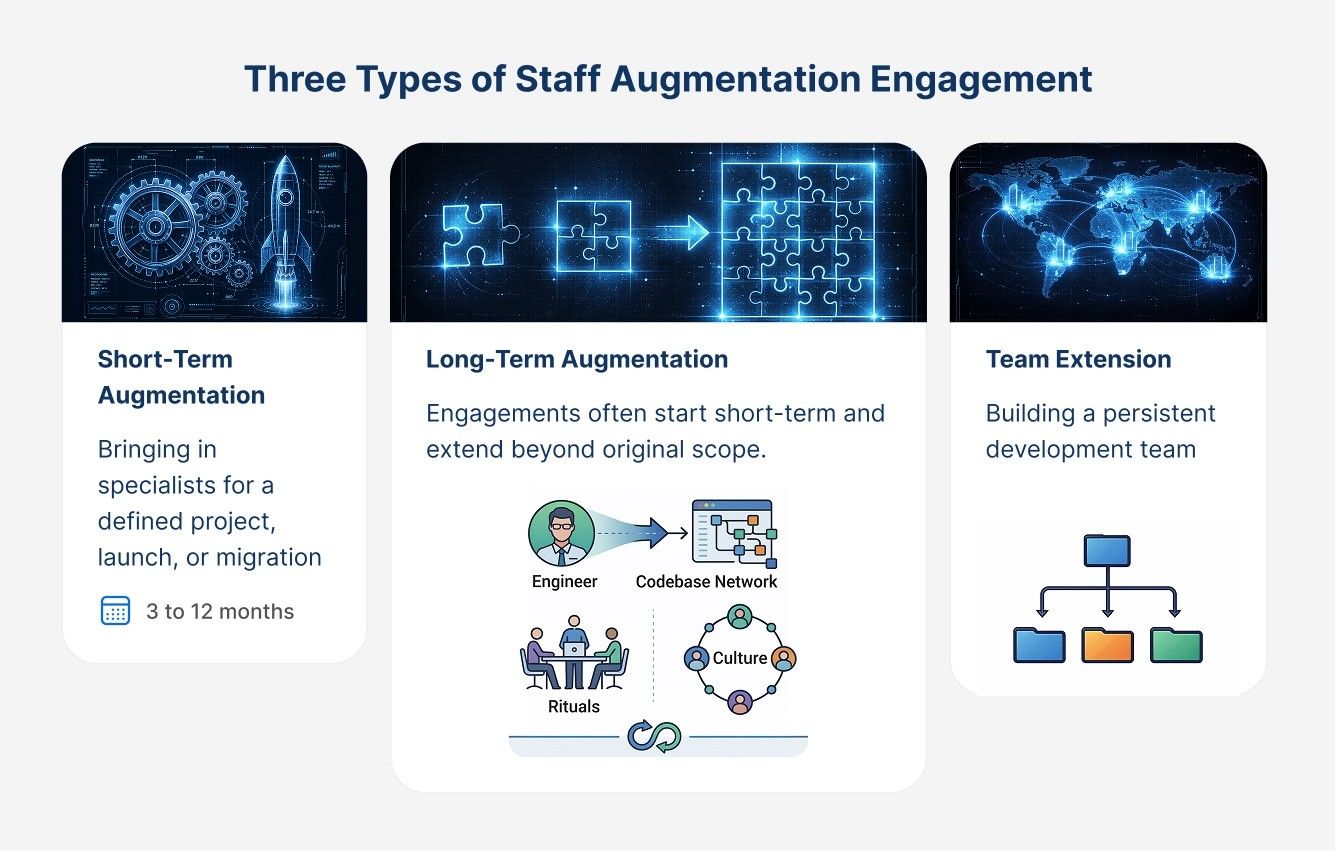
- Short-term augmentation. Bringing in specialists for a defined project, launch, or migration — typically 3 to 12 months.
- Long-term augmentation. In our experience, many engagements that start as short-term projects extend well beyond their original scope. Once an augmented engineer is embedded in your codebase, your rituals, and your team culture, continuity becomes the obvious choice.
- Team extension. Building a persistent development team that operates as an integrated offshore or nearshore arm of your organization.
When to Use IT Staff Augmentation: Five Scenarios
Knowing when to pull the trigger on external scaling is a core competency for modern CTOs. Here are five business scenarios where the debate of IT staff augmentation vs. permanent hiring concludes with augmentation winning.

You Have a Time-Bound Project with a Defined Skill Requirement
If your roadmap includes a cloud migration, a platform rewrite, or a new product feature that requires expertise your team doesn’t currently have — and you won’t need that expertise full-time after delivery — augmentation makes more sense than a permanent hire. You bring in the specialist, deliver the work, and wind down the engagement.
Common examples: a React Native mobile app, a data pipeline built on Apache Kafka, a compliance-driven security audit, or an ML feature layer over an existing product.
Hiring Timelines Are Threatening Your Delivery Schedule
When your sprint is blocked waiting for a backend developer who won’t start for another two months, the business impact is measurable. Sprint velocity drops. Product launches slip. Your existing team absorbs the pressure of carrying an understaffed project. According to Recruiterflow’s Time to Hire Guide, filling software and engineering roles takes 40 to 70 days, with senior positions consistently at the longer end. IT staff augmentation services can fill the same seat in one to three weeks.
The Skill You Need Doesn’t Exist in Your Local Market
According to Statista, the most in-demand roles globally are full-stack and back-end developers, followed by AI/ML specialists, front-end engineers, and DevOps professionals. High demand with constrained supply is what makes these roles the hardest to hire for. If you’re in a secondary market (or a major city with intense competition), finding a senior Kubernetes engineer locally is a multi-month, high-cost exercise. Nearshore and offshore staff augmentation services open that search globally, where equivalent talent pools are available at a much lower price.
Your Workload Is Cyclical or Unpredictable
E-commerce teams scale for peak seasons. SaaS startups surge before a product launch. Enterprise IT teams expand during a digital transformation initiative and then stabilize. Hiring full-time staff for peak capacity means carrying that overhead through the quiet periods. The staff augmentation model lets you scale up when the work demands it and scale down when it doesn’t. You skip the legal, financial, and morale costs of layoffs.
You Want to Test a New Technology Direction Before Committing
Considering a move to Rust, a microservices architecture, or a new AI framework? Augmenting your team with specialists for a 3-month pilot gives you real production data before you make a permanent hiring bet. In software development, technology stacks shift faster than any hiring pipeline can follow. And a failed architectural bet is far more expensive than a short-term augmentation engagement.
Nearshore vs. Offshore: Choosing the Right Geography
When companies move beyond IT staff augmentation vs. full-time hiring discussions and begin selecting providers, geography becomes the next defining variable. The choice between nearshore and offshore engagement affects timezone overlap, communication, cultural fit, and total cost.
Nearshore augmentation means hiring developers in adjacent or nearby time zones. It serves teams that rely on close, instant collaboration. Eastern European talent hubs (Poland, Ukraine, Romania, and Bulgaria) have long provided Western European clients with strong timezone compatibility, high English proficiency, and deep technical education systems. For US-based companies, Latin American hubs (Colombia, Argentina, and Mexico) offer similar proximity and minimal timezone friction.
Offshore augmentation means engaging talent across different time zones, often in the Asia-Pacific region. It grants the highest raw cost savings but requires disciplined asynchronous workflows to function well.
The market appetite for both models is growing fast. According to 360iResearch’s 2026 Staff Augmentation Services Market Report, the global staff augmentation market was valued at $7.29 billion in 2025 and is projected to reach $11.66 billion by 2032, growing at a CAGR of 6.93%. Zoom out further, and the broader outsourcing picture is even more striking: Precedence Research projects the global IT and software outsourcing market to reach $1.345 trillion by 2034.

At GP Solutions, our staff augmentation services operate out of Western and Eastern Europe. This positioning offers a dual advantage: nearshore timezone alignment for our European and US clients, combined with the high cost efficiency of an offshore model. Our developers work inside your Jira boards, your standups, and your processes from the first day of our cooperation.
When Full-Time Hiring Still Wins
IT staff augmentation vs. traditional hiring isn’t a simple win for augmentation in every scenario. There are specific cases where permanent hires are the right answer.

- Core product ownership. Engineers who will own your most critical systems for years, carry institutional knowledge, and make architectural decisions belong on your permanent roster. Continuity here is a product requirement, not an HR preference.
- Culture-critical roles. Engineering managers, team leads, and senior architects define how your team thinks and works. That kind of influence builds over time in ways a fixed-term engagement can’t replicate.
- Regulatory environments. Defense, government, and financial services organizations often operate under compliance frameworks that restrict external access to sensitive systems. Augmentation is possible in these contexts, but it requires additional legal and security structures.
- Long-term cost at high tenure. A developer three or more years into your codebase, fluent in your architecture and your team’s working style, delivers value that is hard to replace. If knowledge-transfer overhead is high, cycling through augmented talent can quietly erode that advantage.
The strongest engineering organizations do not choose between these models. They use both deliberately. A stable core team owns the product and its architectural direction. Augmented specialists accelerate specific initiatives, fill skill gaps, and absorb capacity surges.
Related Case Study
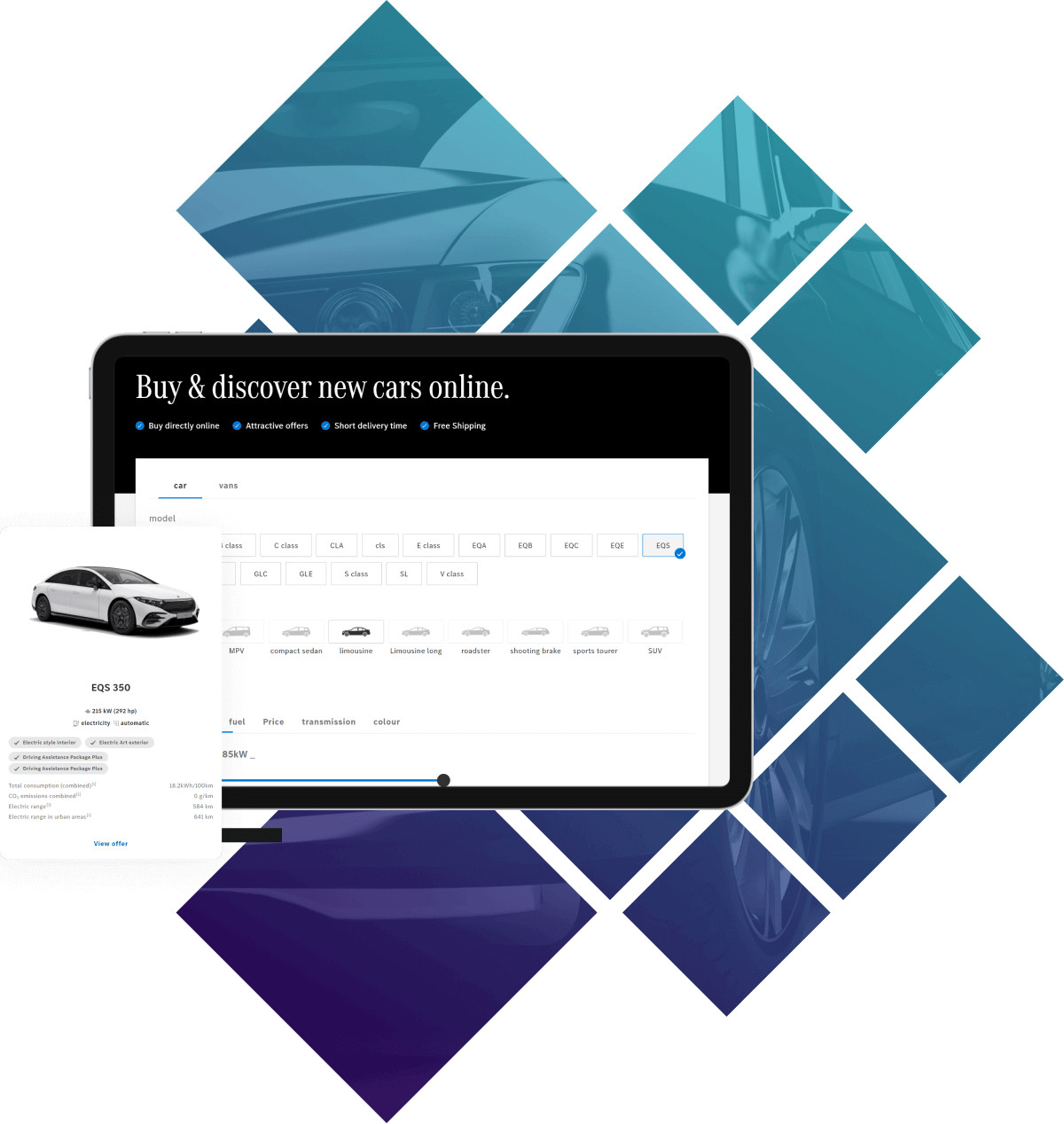
Dedicated IT Services for a Flagship Automotive Company
Related Case Study

Dedicated IT Specialists for Marketing Software Development
Related Case Study

Dedicated Development for a Global Leisure Travel Leader
Ready to Scale Without the Hiring Risk?
There is no single right answer to the augmentation vs. permanent hiring question. Any vendor who says otherwise is selling, not advising.
The right model depends on four variables:
- How time-sensitive the need is;
- How specialized the skill is;
- How long the requirement will last;
- How much downside risk your business can absorb if the scope changes.
If the need is urgent, specialized, and time-bound — augment. If the role is architectural, cultural, and permanent — hire. If your roadmap carries real volatility, build a core team you trust and keep your augmentation layer flexible enough to move with it.
The organizations that scale engineering capacity most effectively are not the ones that picked the right model once. They’re the ones who built the judgment to know which model fits the moment and the partnerships to execute without friction.
Frequently Asked Questions
How quickly can an augmented developer be productive on our codebase?
Faster than most teams expect: typically within one to three weeks of onboarding. The variable is your own setup: clear documentation, a defined ramp scope, and a designated internal contact. Teams that provide that structure consistently see augmented engineers contributing meaningfully inside the first sprint. The bottleneck is rarely the developer.
How do we protect our IP and codebase when working with external developers?
Augmented developers operate under the same legal framework as any external contractor: NDAs, IP assignment agreements, and your internal access control policies. Standard contract language with reputable staff augmentation providers assigns all work product to you by default. For sensitive codebases, role-based repository access and segmented environment permissions are straightforward to implement before day one.
Isn’t staff augmentation more expensive than hiring once you factor in the provider markup?
For short-to-medium engagements, no. And the math is usually not close. A fully loaded full-time senior engineer in the US costs between $210,000 and $380,000 a year. This includes salary, benefits, payroll taxes, equipment, and recruiting fees. An equivalent Eastern European augmented developer runs between $50,000 and $90,000 all-inclusive — provider margin already factored in. No hiring overhead, no benefits administration, no severance exposure if the project scope changes.
What happens if the augmented developer isn’t the right fit?
A reputable provider will replace them. This is one of the structural advantages of the staff augmentation model over a permanent hire. If the match isn’t right, the contract mechanism allows for a swap without legal proceedings, severance negotiation, or the morale cost of a dismissal. Before signing any engagement, confirm that your provider has an explicit replacement clause with a committed timeline. A like-for-like replacement typically takes five to ten business days.
How do we maintain quality and accountability without a direct employment relationship?
The same way you manage any senior contributor: clear goals, regular check-ins, and visibility into their work. Augmented developers attend your standups, report to your leads, and operate inside your existing tools. The accountability structure is yours to define. A missing employment contract shouldn’t change the dynamic if the engagement is set up correctly from the start. Teams that struggle with external quality almost always share the same root cause — they gave developers access without giving them context.